
The History of Pimple Patches: From Ancient Remedies to Dermatologist-Approved Innovation
A deep dive into how humanity has always fought the blemish — and why modern science finally got it right.
- By The Skin Doctor's Team
- March 13, 2026
- 8 min read
- Dermatologist-Created
- Dermatologist-Tested
- Dermatologist-Approved
Acne is as old as humanity itself — but the idea of placing a small, targeted patch directly over a blemish to speed healing? That's a story of centuries of trial and error, brilliant biomedical engineering, and finally, dermatologist-led science that delivers real results.
A Brief History of Acne Treatment: The Long Road to the Patch
To appreciate where pimple patches are today, you have to understand where we came from. Acne has plagued humans since at least 3000 BCE – ancient Egyptian papyri describe sulfur-based pastes applied to blemishes. Roman physicians prescribed crocodile fat and honey. In medieval Europe, bloodletting and herbal poultices were common “cures.” None of them worked particularly well, but the impulse was always the same: put something on the blemish, keep it covered, draw out the impurity.
That instinct was directionally correct. It just took until the 20th century – and a serendipitous discovery in wound care – for science to finally catch up with it.
The Wound Care Discovery That Changed Everything
In the 1980s, clinicians studying wound healing made a pivotal observation: wounds that were kept moist healed significantly faster and with less scarring than those left exposed to air. This led to the development of hydrocolloid dressings – gel-forming agents sealed within a flexible adhesive film – which quickly became the gold standard for managing chronic wounds, ulcers, and blisters in medical settings.
Hydrocolloid works by absorbing fluid (including pus, oil, and bacteria) from a wound while creating a moist microenvironment that accelerates cellular regeneration. It also forms a physical barrier against contamination and – critically – against picking. Dermatologists noticed something interesting: when these dressings were placed over inflammatory lesions, the results were striking.

Key Insight
The same technology used to heal surgical wounds and pressure ulcers in hospitals became the scientific foundation for the modern pimple patch — a crossover born from decades of clinical wound-care research.
How We Got Here: A Timeline of the Pimple Patch
Ancient Spot Treatments
Egyptians, Romans, and Ayurvedic practitioners apply targeted pastes and poultices to blemishes — the earliest conceptual ancestors of the spot treatment.
Benzoyl Peroxide & Retinoids Emerge
Modern pharmaceutical acne treatments arrive, targeting bacteria and cell turnover — effective but often harsh, drying, and indiscriminate.
Hydrocolloid Dressings Revolutionize Wound Care
Medical-grade hydrocolloid bandages enter clinical use, demonstrating superior moist wound healing outcomes that would later inspire skin care innovation.
South Korean Beauty Pioneers the Pimple Patch
K-beauty brands begin adapting hydrocolloid technology into small, discreet patches specifically for acne. The concept spreads rapidly across Asia, building a loyal following.
Global Mainstream Adoption
Pimple patches go global. Brands like COSRX introduce them to Western markets. Social media accelerates adoption — the satisfying "whitening" effect of a used patch becomes a viral phenomenon.
The Dermatologist-Led Evolution
The category matures. Consumers demand more than basic hydrocolloid — they want clinically validated formulations, active ingredients, and dermatologist involvement from the ground up. The Skin Doctor's Pimple Patches are born.
What Makes Pimple Patches Different from Everything That Came Before?
For decades, the standard approach to treating a blemish at home followed a frustrating script: apply a harsh topical, wait, pick at it anyway, make it worse, and repeat. Conventional spot treatments — lotions, creams, and gels — had a fundamental flaw: they sat on top of the skin and evaporated, washed off or transferred onto pillowcases & bleached fabrics long before they could do their work.
Pimple patches changed the equation in several profound ways:
Targeted, Occlusive Delivery
Unlike creams that diffuse across the entire face, a patch creates a sealed, localized microenvironment directly over the blemish. Active ingredients stay concentrated exactly where they are needed, with none of the collateral irritation to surrounding healthy skin. The occlusion also enhances ingredient absorption — a phenomenon well-documented in dermatological literature.
Hydrocolloid Fluid Absorption
The core mechanism of a quality pimple patch is not just what it puts in — it’s what it draws out. Hydrocolloid polymers are highly hygroscopic, meaning they absorb wound exudate including sebum, pus, and bacteria from whiteheads. As the gel absorbs fluid, the patch visibly turns white — a confirmation that the mechanism is working.
An Anti-Picking Barrier
Picking and squeezing blemishes drives bacteria deeper, causes micro-scarring, and prolongs healing time. A pimple patch functions as both a physical deterrent and a reminder. When the patch is on, the blemish is off-limits. This single behavioral benefit may be the most underrated contribution of the patch format to acne outcomes.
Discretion and Wearability
Modern pimple patches are nearly invisible — thin, flesh-toned, and low-profile enough to wear throughout the day, not just overnight. This means the treatment doesn’t stop when you leave the house, dramatically increasing total treatment time and efficacy.
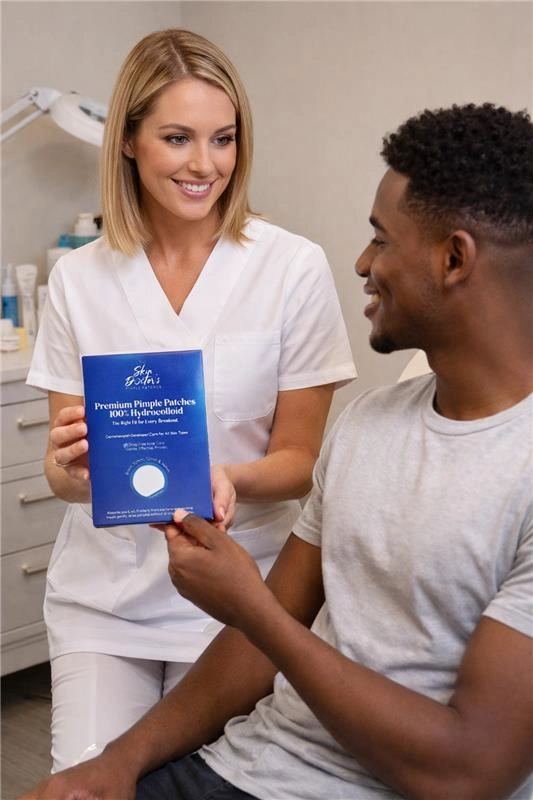
“pimple patch carton enlarged for better viewing”
"The concept is beautifully simple: bring the treatment to the blemish, keep it there, and let the science do its job — without interference."
The Skin Doctor’s Pimple Patches
Pimple Patches vs. Conventional Acne Treatments
Context matters. Here’s how the patch format compares to the alternatives most people reach for first.
Traditional
Spot Creams & Gels
- Evaporate or transfer before fully absorbing
- irritate surrounding healthy skin
- No barrier against picking
- Require repeated reapplication
- Little clinical differentiation between brands
Topical
Prescription Treatments
- Highly effective for chronic acne
- Not designed for acute spot treatment
- Can cause dryness, peeling, photosensitivity
- May be costly and may not becovered by insurance
- Overkill for occasional blemishes
Basic
Generic Pimple Patches
- Basic hydrocolloid only - inferior in absorbing fluid and oil from pimples (generally superior in absorbing fluid and oil from "active" whiteheads)
- No dermatologist involvement in formulation
- No clinical testing or validation
- Variable adhesion and patch integrity
- Not differentiated for blemish type
Advanced
The Skin Doctor's Pimple Patches
- Dermatologist-Created formulations with targeted actives
- Medical grade and Dermatologist-Approved
- Premium hydrocolloid matrix with proven absorption
- Day and overnight wear options
- Science-first approach with visible results
What Sets The Skin Doctor's Pimple Patches Apart
Not all pimple patches are created equal. The market is flooded with options, but very few begin where ours do: in the clinic, with dermatologists, guided by evidence. Here is what makes The Skin Doctor’s Pimple Patches the clear choice for anyone serious about their skin.
01
Dermatologist-Created From Day One
The Skin Doctor’s Pimple Patches were not formulated by marketing teams and then handed to a lab. They were conceived, developed, and refined by practicing dermatologists who understand acne at a cellular and clinical level. Every ingredient choice, every concentration, every patch thickness reflects real clinical knowledge — not trend-chasing.
02
Dermatologist-Approved
There is a meaningful difference between a product that pays a dermatologist to appear in an advertisement and one that has earned genuine dermatologist approval through merit. The Skin Doctor’s Pimple Patches carry approval that is rooted in the data — formulation safety, clinical efficacy, and patient outcomes that dermatologists trust.
03
Advanced 100% Hydrocolloid
Our hydrocolloid is not an afterthought. The matrix is engineered for optimal fluid absorption capacity, ensuring the patch draws out sebum, pus, and impurities efficiently while maintaining a moist healing environment. The result is visible action — and faster, cleaner resolution of blemishes.
04
Targeted Active Ingredients, Clinically Justified
Where other pimple patches stop at the hydrocolloid substrate, The Skin Doctor’s Pimple Patches go further. Our formulations incorporate clinically validated actives — selected not because they are trendy but because dermatological science supports their inclusion and their delivery via patch format enhances their efficacy profile.
05
Designed for Every Skin Type and Blemish Stage
Skin is not one-size-fits-all, and neither are blemishes. Our range is developed with an understanding of acne pathophysiology — addressing surface whiteheads, deeper inflammatory lesions, and the post-blemish healing phase with formulations calibrated for each stage and skin type, including sensitive skin.
The Bottom Line
When you place a Skin Doctor’s Pimple Patch on your skin, you are placing the output of real dermatological expertise on your skin. That is a distinction that matters — and one that is reflected in every result.
The Future of Pimple Patches
The pimple patch has come an extraordinarily long way from sulfur pastes on papyrus. Hydrocolloid technology will continue to advance, delivery systems will become more sophisticated, and the integration of active ingredients with patch formats will deepen. Microneedle patches — already emerging in clinical contexts — hint at a future where the patch format can deliver ingredients transdermally to treat deeper cystic lesions.
But the most important evolution in the category is already underway: the shift from mass-market novelty to clinically Credible, Dermatologist-Driven Skin Care. Consumers are becoming more sophisticated. They are asking harder questions: Who formulated this? What does the evidence say? Who tested it on real skin?
Those are exactly the questions The Skin Doctor’s Pimple Patches were built to answer — not with marketing language, but with the credentials, the process, and the results to back it up.
We have come from crocodile fat to clinically tested hydrocolloid infused with dermatologist-selected actives. The history of acne treatment is, in many ways, the history of science finally catching up with an ancient, universal human frustration. We are proud to represent where that history has arrived.
Pimple Patches
Acne Treatment
Hydrocolloid
Skin Care Science
Dermatologist Tips
Blemish Car
K-Beauty History
Clear Skin
Experience Dermatologist-Led Acne Care
The Skin Doctor’s Pimple Patches — created, tested, and approved by dermatologists for visible results you can trust.